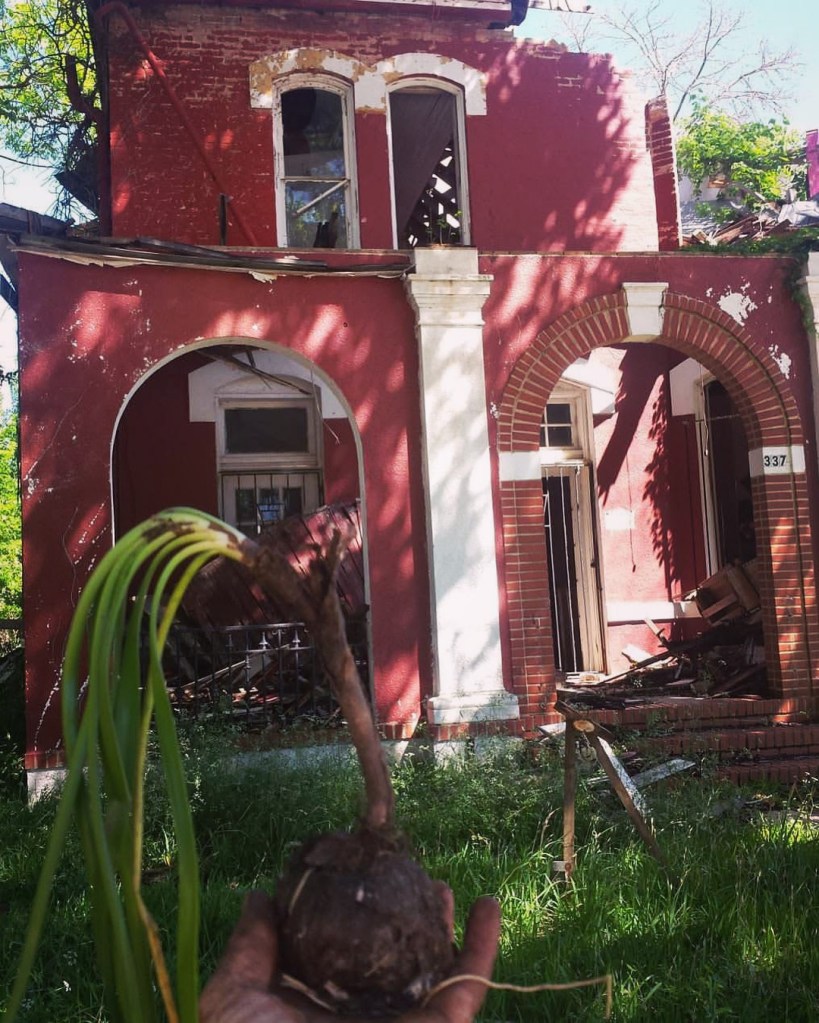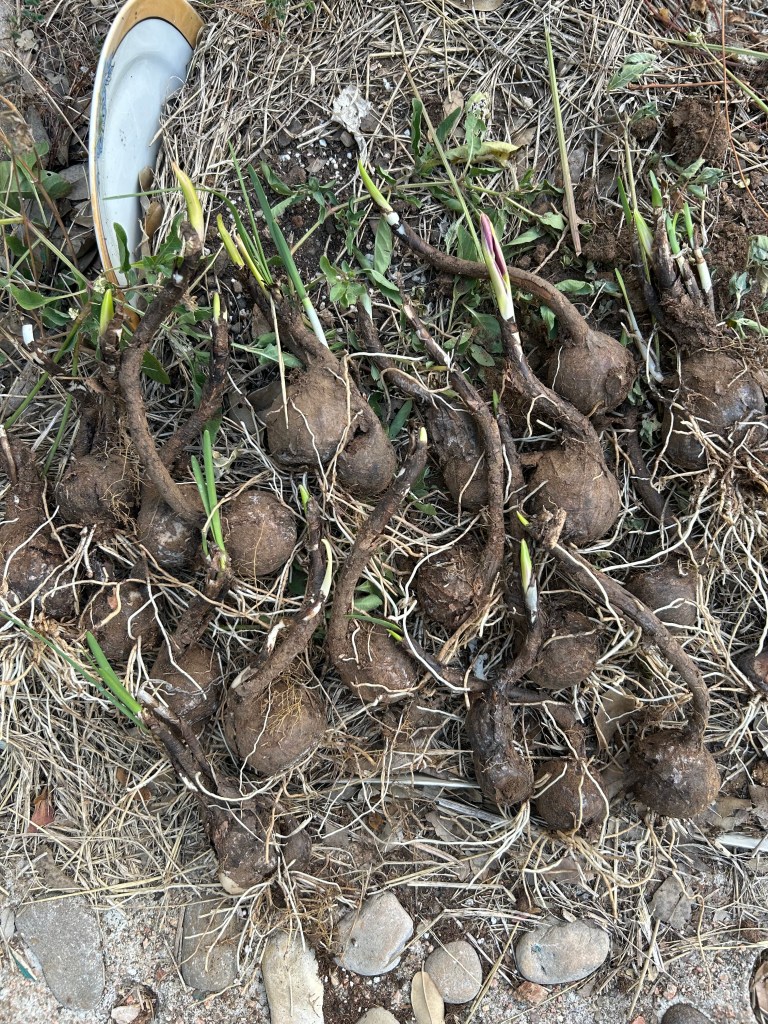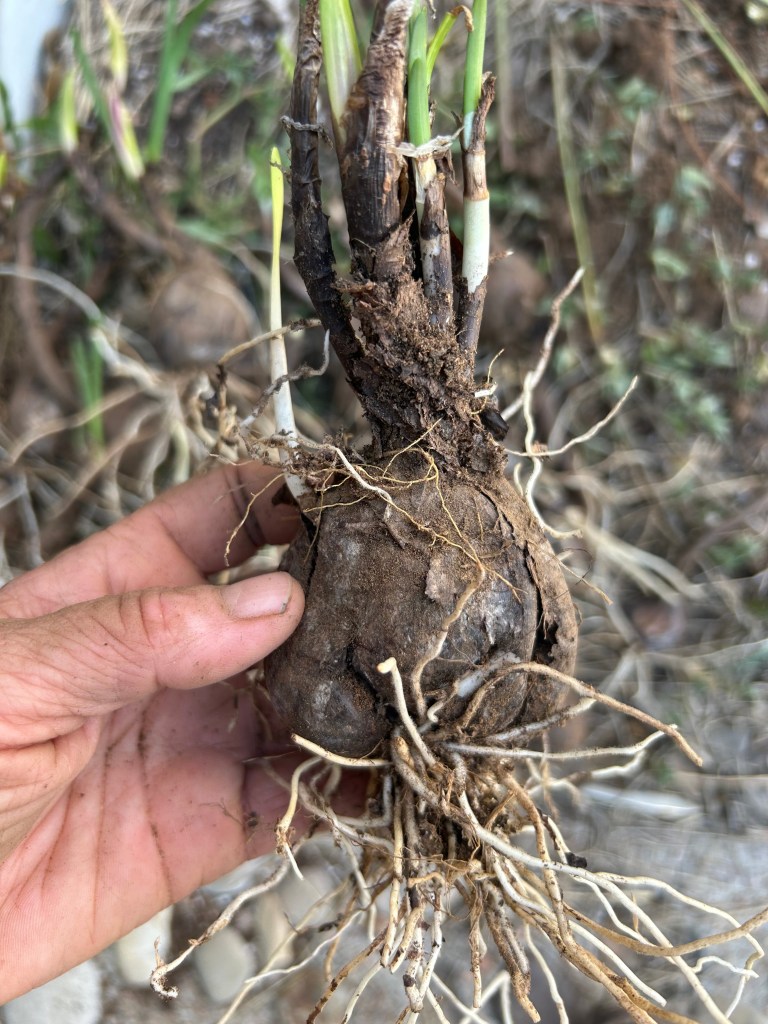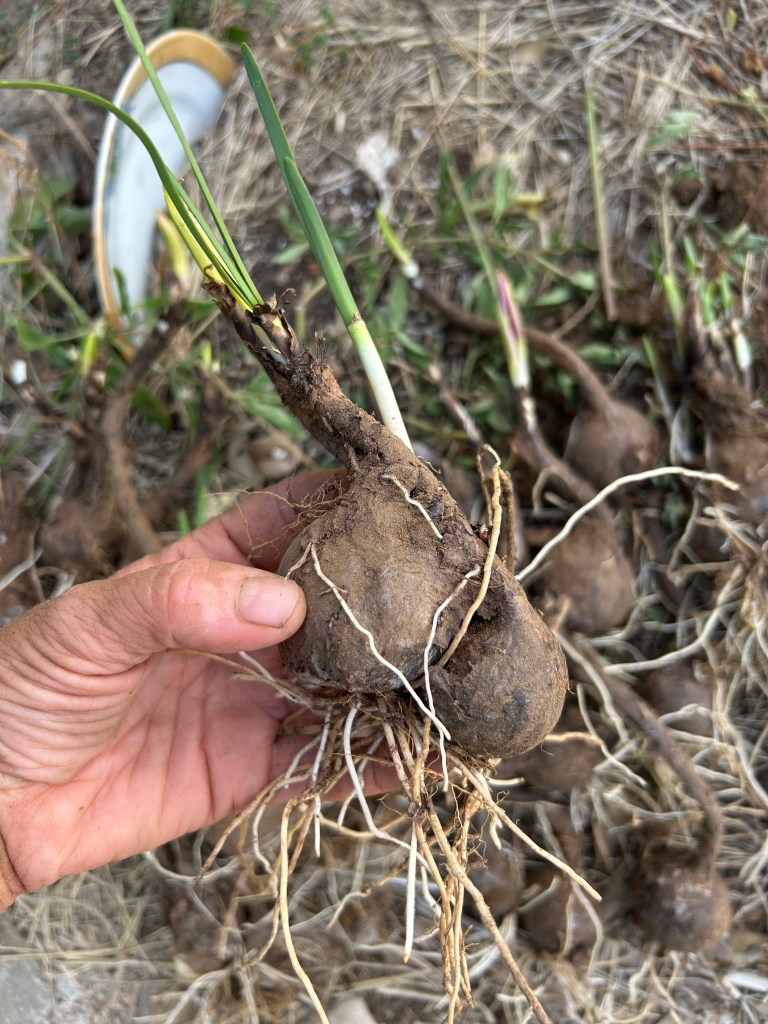
There are a lot of meaningful endeavors in life, but saving Miss Margaret’s gardens is definitely one of my favorites. I’m honestly not sure why I’m so passionate about old flower bulbs, but the only way to explain it is that it’s in my blood. My Dad loved old architecture and old photos. As a child, my Dad instilled a profound understanding of preservation. A deep desire to save something that will be lost. When I see bulb foliage, there’s a sudden urgency to hop barbed wired fences with a shovel. My son even bought me a mini shovel to carry around in my car. I must admit, my little digging passion is just weird. I can’t explain it. I’m just compelled to hop that fence. I feel like an addict, desperately seeking my next fix of old rotting houses and “No Trespassing” signs. If I had a dollar for every time my family told me “We aren’t bailing you out of jail” I’d be rich. There are countless reasons why I shouldn’t do what I do, and only one reason why I should….the beautiful 100 year old Oxblood Lily bulb that I’m holding in my hand.
She survived the Great Depression.
She survived World War 1 and World War 2.
She survived floods.
She survived drought.
She survived decades of love and care.
She survived decades of neglect.
She is a worthy preservation project indeed! It is hard to imagine the changing landscape that little bulb experienced over her last 100 plus years. Even if, for no other reason than antiquity, that flower bulb deserved to be saved.
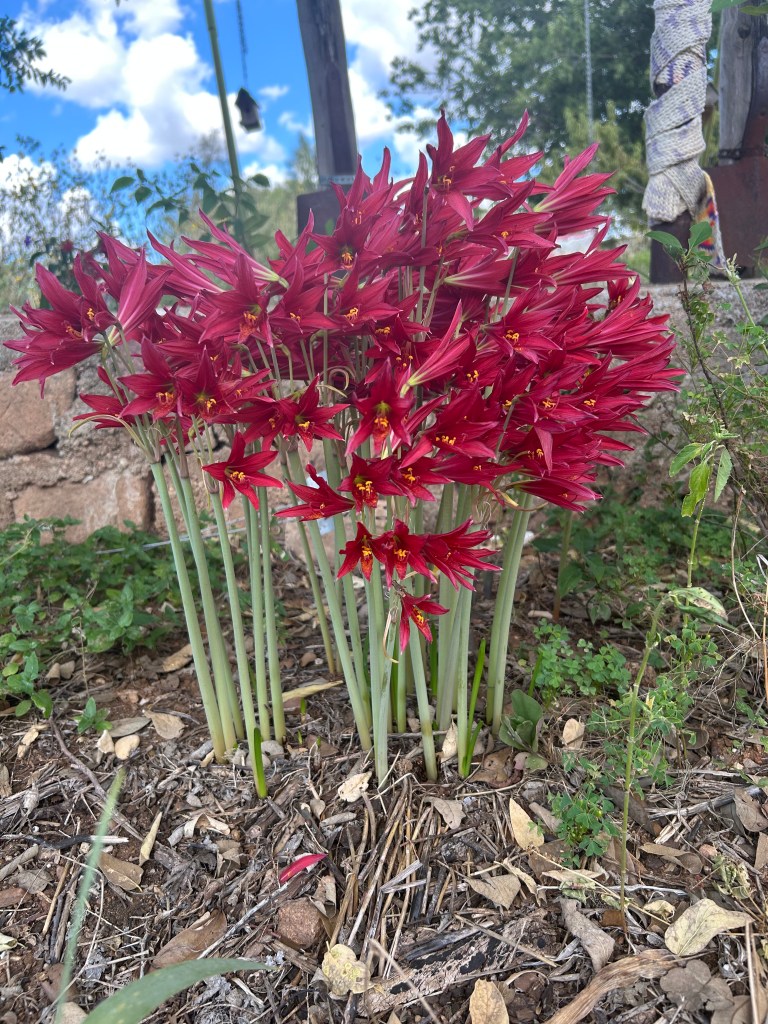
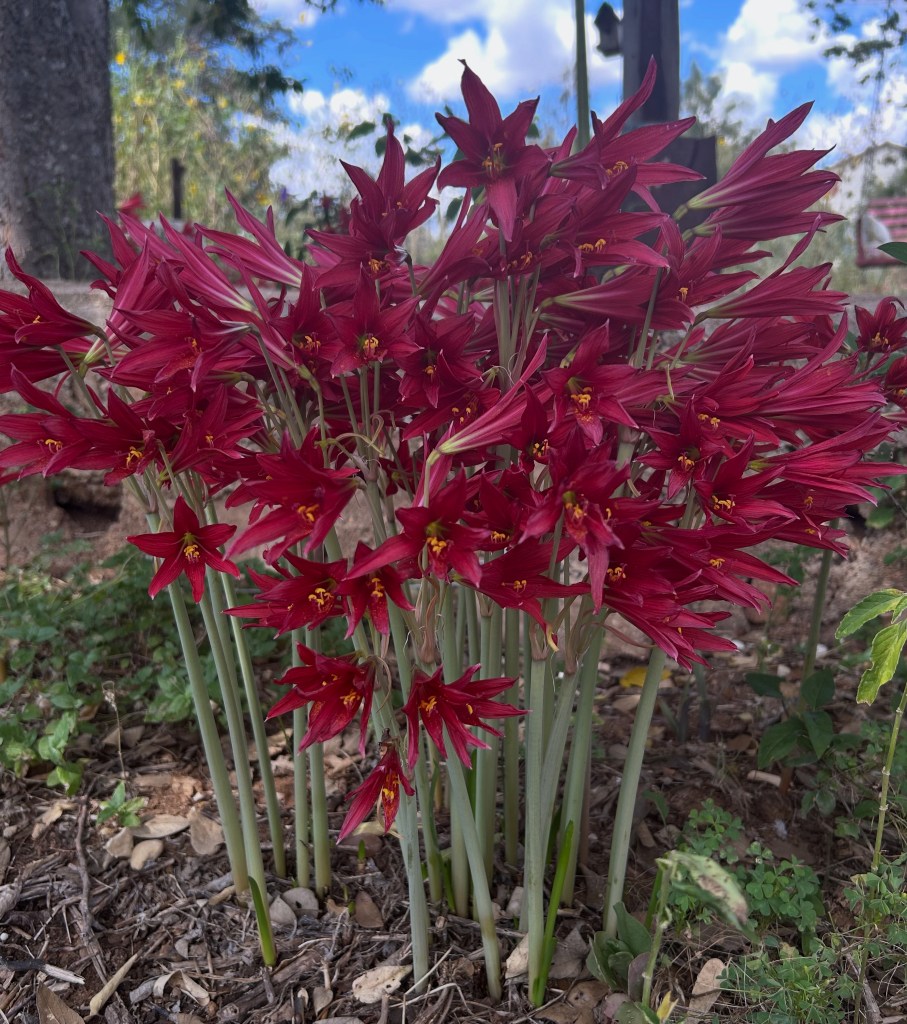
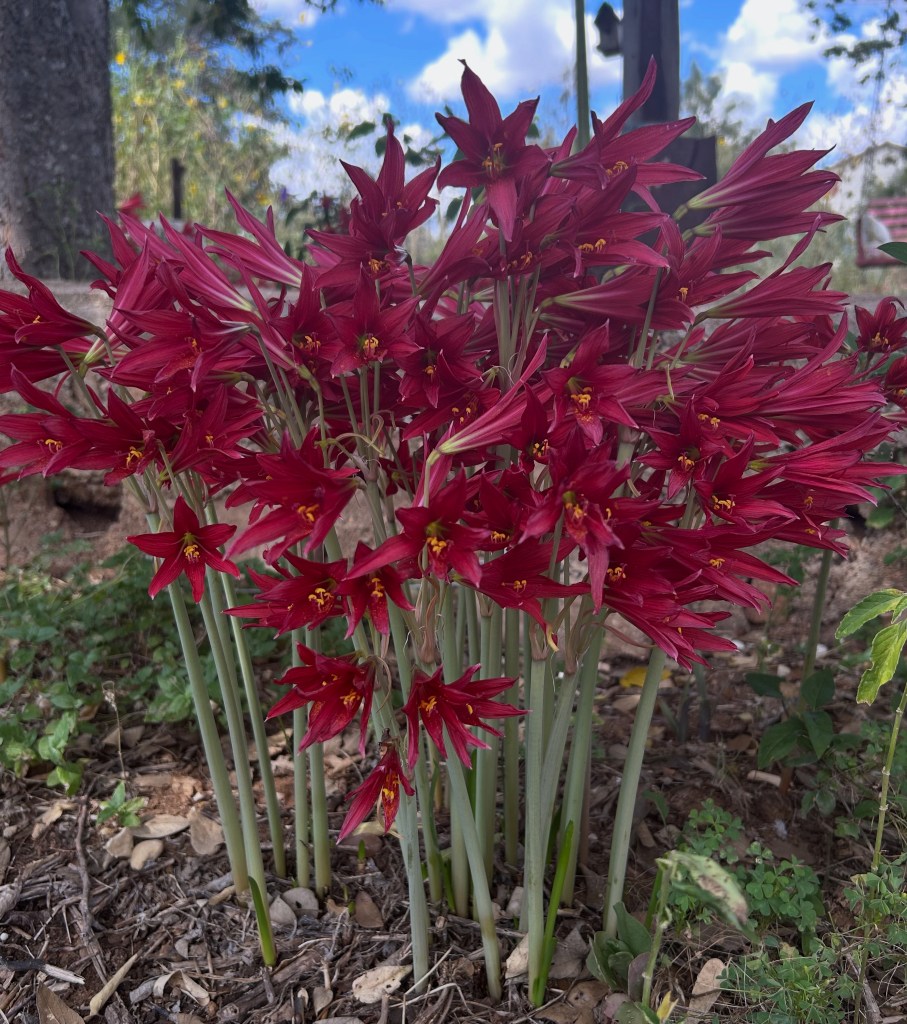
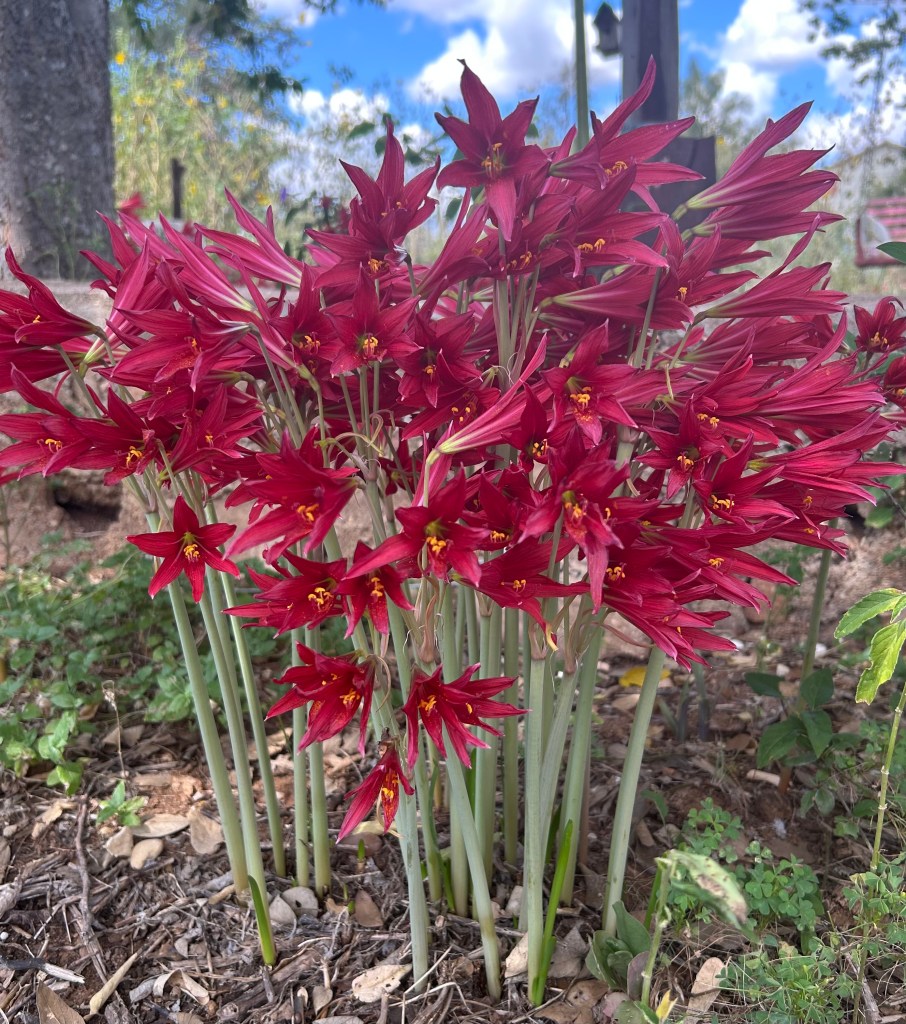
Just look at Miss Margaret’s lovely Oxbloods! Happy, healthy and preserved for generations to come.
What became of Miss Margaret’s gardens? Well, that is a sad story for another day. Most of the bulbs were salvaged, the historic house was demolished, and the land became a cemented parking lot. I can still see the stained glass and the curled wooden staircase in my mind. If you are able to come to the Agape Haus Studio open house on Dec 20th, rumor has it that Santa left Oxblood Lilies for gifts for everyone! 🙂
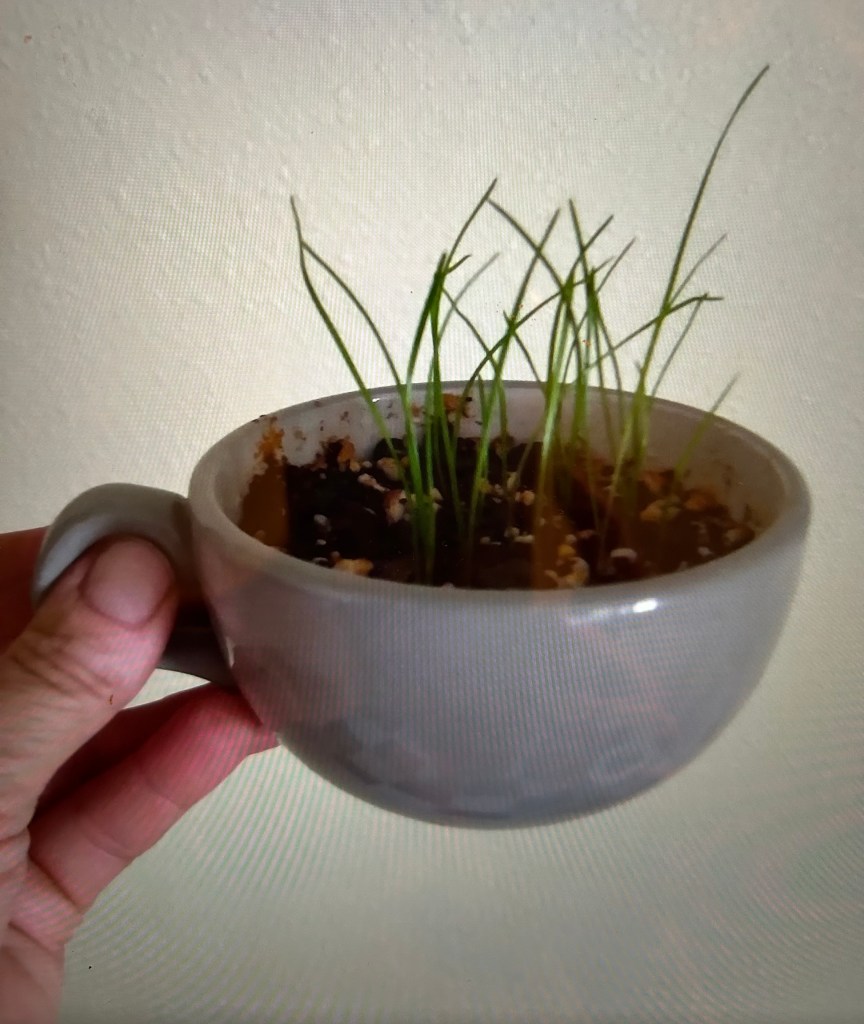
Honestly, is there anything cuter than baby lilies? Well, maybe baby puppies or baby nieces. Complete cuteness overload!
I, for some odd reason, feel a deep maternal love towards baby lilies. The art of seed collecting is a long, mundane process; but then again, so are diaper changes. We don’t throw the baby out with the bath water, so lily seed collecting can be a worthy endeavor. I have been collecting, germinating and growing baby lilies for years. I’ve had more failures than wins along the way, but I find that growing lilies from seed is a nice exercise in patience. If you so choose to take the challenge, here are a few simple steps to get started.
First, you need some Oxblood Lilies that reseed. Not all my lilies reseed, and quite honestly, I’m not sure what the perfect conditions are. A lot has to do with the amount of water the bulbs receive during bloom time, and the weather conditions after the bloom. If temperatures get too hot too soon, the seed pods will dry up. Last year, the seed pods went into over-drive and I ended up with way too many baby bulbs. I mailed many packs of germinated seeds out to gardeners from all over who wanted to try this lovely seed-germinating process out. This season, the pods appeared overnight, and then we left for Colorado for our son’s wedding.
For a brief moment, I thought about hiring a baby-sitter for the baby lilies. I realized that this sentiment was a bit too much…..So I decided to stay home from the wedding.
Just kidding.
Step two….Allow the seed pods to get nice and fat like the ones pictured above. The seeds on the inside will be thin and black, very similar to other rain lily seeds. Most rain lily seeds are ready to sprout almost immediately with water…hence the name “Rain Lily”.
Step three….Place the seeds in either a wet paper towel or little teacups. I go back and forth between which method I prefer. Since I am in Colorado, and my seed babies are in tea cups in Texas, I prefer the paper towel method. At the moment, I’m concerned everything will dry out and all lily babes will be dead. I can’t be worried about baby lilies though….It’s my son’s wedding after all. Priorities.
Step four..Keep the babies fed. Whether you use the paper towel method or little tea cups, don’t let the seeds dry out. The seeds in a paper towel will get transferred to tea cups or pots within a few weeks. The tap roots for these little baby bulbs is longer than expected. They drink a lot of water. Keep the babies in dappled shade or inside in bright light. Again, don’t let them completely dry out. I’ve made this mistake and lost many, many baby bulbs this way. Always a sad time to lost something you’ve worked hard at.
Step five….The fine art of patience.
Wait. And wait. And wait. And wait. And waaaaaaaaaaaaaait…
Voila! Oxblood Lilies are worth every moment of patience.
if you would like some Oxblood Lilies, please let me know. I’m always happy to share. If you are a garden center, I’m happy to help you out with lilies as well. Come on by to the Agape Haus Studio & Garden! I love to grow things, but I’m not interested in selling. Not even a little bit. A little donation to keep the gardens composted is enough for me. I just want to share these heirloom bulbs with fellow gardeners. Email heirloombulbgirl@gmail.com for more info.
The first Saturday in October is the Llano Master Gardeners Native Plant Sale. I will be hanging out alongside the Llano Master Gardeners with four varieties of Heirloom Bulbs. If you’ve never been to the Native Plant Sale, this is the year to do it! The sale is 8-12 am, although all plants sell out quick.
Heirloom Bulbs available are Oxblood Lilies, Ellen Bosenquat Crinum, Milk and Wine Crinum and the large Prarie White Rain Lily. All bulbs have been collected by yours truly from old homesteads that were being torn down. All bulbs are drought hardy, tough southern bulbs that are an asset to any garden. Hope to see you at the Llano Plant Sale!
Just look at that! What a sweet family photo! Scott Ogden, in his book Garden Bulbs for the South, describes the growth of Oxblood Lilies perfectly… “No other Southern bulb can match the fierce vigor, tenacity, and adaptability of the Oxblood Lily.” After 30 years of rescuing, growing and preserving Heirloom Oxblood Lilies from old German homesteads, I have to agree. There is an incredible family unit that is found in each clump of bulbs that has been lifted.
Scott Ogden came for a visit after our house was destroyed in the flood in 2018. I was in the process of moving all the gardens and bulbs to Agape Haus Studio & Garden. Scott had heard that I had lost my cherished copy of his book, so he and a gardening friend came and brought me a signed copy! We walked through the gardens, and I showed them my restoration goals for the scrappy, rock-infested land. I also showed them the beautiful old Live Oak trees with sandy loam conditions that were PERFECT for bulbs. They both looked at me like I was crazy.
“That’s a lot of work”
After all, I was a full-time working musician with a family to tend to.
“Well, I *did* tear down an old ratty house next door, in between violin lessons, just to save that tree. Crazy is as crazy does.” 🙂
I grabbed a shovel and dug up an enormous clump of old Oxbloods. This multigenerational family of Oxbloods had been featured in an article “Saving the Gardens for Miss Margaret”. Scott and Greg couldn’t believe how huge the clump was, and how many hundreds of bulbs were in that bulb family clump! They also couldn’t believe that I was “just giving” them these beloved bulbs. Yes, Oxbloods have a pretty high street value for fellow gardeners. In my mind, no one really “owns” their flowers…they are meant to be shared and enjoyed. We are all just care takers for the Lord’s creative beauty through nature and gardens.
As Oxblood Lilies grow, the old bulbs get older and larger, babies bulbs grow and swirl around the parent bulb until they finally grow big enough to be on their own. These offshoots then split off and start their own little families. The baby bulbs grow into parent bulbs…hence, the multigenerational aspect of the Oxblood Lily. Yesterday I dug up a nice clump for donation. As I divided the bulbs, I counted 22 very large old Grandparent bulbs, not including the all the parent and littles. Old bulbs grow and multiply faster than smaller bulbs, but don’t worry, we all become our Grandparents’ someday! We just need to keep nurturing and watering during growing season.
if you’d like to have some beautiful Oxblood Lilies added to your garden, simply email me, check out Etsy (it’s usually sold out tho) or come see me at the studio 1st and 3rd Fridays, by appointment.
A few weeks ago, the first of the Oxblood Lilies appeared. This is always a glorious time for the Southern gardener, and a beautiful way to welcome in the Fall. The first flush of Oxbloods is a sigh of relief. Summer is finally over! I imagine the first few blooms are likened to that of a reconnaissance crew, just checking out the weather and overall surroundings to make sure it is, in fact, Fall. The first flush is nice, but the second flush is the real deal…
The homemade fudge sauce on an ice cream sundae. The quiet, gentle snowfall on Christmas Eve. The green piece of sea glass on a beach in Cornall, England.
The second flush of Oxblood Lilies is nothing short of magical. The rich, intoxicating shades of dark, crimson red are exactly what one would imagine an Oxblood Lily should look like. During the second flush, the weather has also cooled down a bit (supposedly), and the flowers last much longer. The growing conditions become much more favorable of having viable seed-producing pods. I’m not sure if all Oxbloods have the “second flush” growing habits. An Oxblood clump has to become established to provide numerous blooms. Given enough time, your Oxbloods will be a multigenerational family of bulbs.
The attitudes of Heirloom Oxblood Lilies that are 100 year old stock (and beyond) are quite different than other young whipper-snappers in the garden. These old gals have been through a lot…the Great Depression, World Wars, the Beatles, the technology age of garden neglect and homestead teardowns. That’s a lot for an old bulb to take in and process. If the weather isn’t quite right, the main flush will simply hold off. Patience is indeed a virtue. In my garden, the first flush typically contains only a few scattered blooms out of each clump. Yes, they are lovely to behold and yes, I do enjoy the first flush as much as I love a single chocolate cookie right out of the oven. But the second flush…Omygoodness. The second flush is the entire plate full of warm, gooey, right-out-of-the-oven chocolate chip cookies. It’s simply incredible.
Please reach out and let me know how your Oxbloods are doing. I do have Oxbloods available if any of you are without. It’s never good to have a garden with bulbs. email Heirloombulbgirl@gmail.com for more information.
Until then, enjoy this wonderful season of Oxbloods! Happy Gardening, my friends!
I love it all. I’ve always been drawn to antiquity, whether it is a flower, an old black and white photo, historic buildings or a page of music that my violin teacher’s teacher wrote upon in the early 1900’s. My love towards preserving the unseen or the forgotten has been a passion for as long as I can remember. Love can be manifested in many different ways. The love and preservation of the Heirloom Flower Bulb has been a deep-rooted passion since for as long as I can remember.
My first taste of an Heirloom Bulb came literally in the form of a beautiful pink cabbage-petaled Peony. Peonies smelled intoxicatingly delicious, and well, yes… I licked the sap off those gorgeous flowers. Licking sap off the Peony is not recommended as peonies are poisonous. Children, like myself, are not meant to play “Bumblebee” with poisonous plants. In fact, I often tested my boundaries with the wild things by way of eating wild mushrooms, the neighbor’s raspberries, random flowers and lilacs. I loved all flowers, even the ones I ate, but I grew very fond of the old Peonies. It fascinated me that flower bulbs came back year after year, no matter what. As a child, this was nothing less than magical.
Neighbors down the street noticed my love for flowers and poured their knowledge into me. Rabbi And Mrs. Horowitz greeted me at their front door with scissors and a vase. I suppose they knew that I would hack at their Heirloom Roses inappropriately if they didn’t teach me properly. I have such fond memories of their gentle ways, the beautiful rose garden in their backyard with heirloom rose cuttings that came from their own family members. Mrs. Horowitz took time sharing the stories of her roses and taught me, a young child, how to love and respect old plants. (I have tried to create a rose garden in their honor, but unfortunately the gophers have other plans).
After the Peonies and the Horowitz Heirloom Rose Garden of my childhood, I became an Heirloom Iris addict. It wasn’t long after my family relocated to Colorado Springs that I found an abandoned Iris garden in the empty lot next to our house. My Dad and I spent hours unearthing the old fountain and Iris rhizomes that had been covered up after decades of neglect. A neighbor had told us that at the turn of the century, the gardens on West Cheyenne Mountain Road were eye-stoppers. The neighbor actually showed us an old black and white photo from the 1940’s of cars lined up to simply drive by the gardens. Rare black Iris were in abundance. We lived in that house just one year, but it was one of my favorite houses that I ever lived in. Years after we moved, I took my own little family by the old Cheyenne Mountain house in hopes of retrieving some historic Black Iris. Unfortunately, much to my great sadness, the gardens were bulldozed and the lovely lot became a common McMansion. I will always treasure those timeless moments of sitting on the ground with a hand shovel, gently unearthing the garden alongside my Dad.
Fast forward to my early twenties. I was now in central Texas during Fall. Need I say more? It rained, and what seemed like overnight, Oxblood Lilies popped up all over town. I’ve never been the same since. Oxblood lilies seemed to grow wild where my in-laws lived, and I began to ask around about the red lilies growing everywhere.
“Those are just weeds”
“Well, can I dig up your weeds then?”
“Help yourself”
Thus started the first bulb dig 32 years ago this Fall. I’ve been digging ever since. I’ve salvaged a lot of old bulbs from homesteads and historic home teardowns. I’ve jumped barbed wire fences, been face-to-face with rattlesnakes, dug in the rain in front of bulldozers, broken more shovels than I care to admit and all the while…the Lord keeps whispering “Just Keep Digging”
Honestly, I don’t even know why. My hands hurt, my body aches and I have countless thorns in my fingers on any given day….and I love every minute of it. 🙂
We’ve all read “ To plant a garden is to believe in tomorrow.” Heirloom Bulbs live that quote. They are worthy of every single “blood, sweat and tears” (and broken shovels) of bulb rescues.. Heirloom Bulbs will outlive your grandchildren’s grandchildren. This weekend, the Rockwall Master Gardeners are doing a very special class featuring Heirloom Bulbs. Chris Weisinger, from Southern Bulb Company, will be giving a presentation. You can purchase Heirloom Bulbs from them. A fantastic way to start your weekend!
The last week and a half have been beyond any words. I honestly have nothing. There are simply not enough sentiments to express the sorrow of the loss of children and families during the devastating flash floods in the Texas Hill Country. The damage is overwhelming, but the loss of life is gut-wrenching. God promises that He will turn “mourning into dancing” and “Graves into Gardens”, as I was reminded by my student Malaya’s father. Malaya helped save her siblings from their van that was swept into the water, but unfortunately, she didn’t make it.
Turn mourning into dancing? Graves into Gardens? How is that even possible? As a mother, I could not imagine that there would ever be a day that I could dance again. But time is nothing to God. God dwells in the eternal. He sees the lives touched by the last moments of goodness. He sees beyond. He sees the light of those that have been brought to literally to millions. It’s hard to fathom, but Faith must to step in and carry our heartbreak for us.
Faith is there to pick us up when we fall on our faces in grief.
Faith is there to guide us when we can’t move forward.
Faith is there to gently encourage our broken hearts.
There is no answer to the age old question..Why? Why do bad things happen to good people, and why do good things happen to bad people? Why do children get hurt? Why the pain and destruction of this world? I cling to the promises of the Lord. There will be a day where there is no more sorrow, no more tears, no more pain and no more heartbreak. The lion will lie down with the lamb and be at peace.
Until that day, we carry on. We do what we can for our neighbor, and we love God through the high moments of life, and through the lowest of lows. We have no words, only acts of random bits of kindness and comfort.
I don’t have much, but I do have flower bulbs. I’m offering a sweet family of Oxblood Lilies, in honor of my student Malaya Hammond, with 100% donation going to families affected by the devastating floods. I know three families personally, as well as the loss of Malaya, a beloved viola student. You can purchase bulbs on Etsy, contact me by email, or reach out to me somehow. All proceeds (after shipping/fees) will go directly to donation. I’ve been using Venmo, with a picture receipt for each donation. There is a children’s grief camp, Ark, an organization that helped us during the 2018 flood. Ark is mucking out houses and providing housing, clothes, furniture etc at no cost, as well as the individual families I’ve mentioned. Thus far, Heirloombulbgirl has raised over $900 and has already sent it on out to families! Thank you to every who already ordered and “planted joy” in the midst of sorrow. We are called to make the world a better place, and to be the “light on the hill”….Malaya, your sweet soul lived that. For more information, please feel free to email Heirloombulbgirl@gamil.com
This is the year of restoration. This is the year that the gardens won. The wildflowers beat the odds, through drought and early heat, and still flowered on. The beauty of the meadow has finally appeared, and the wildflower seeds that were collected and sowed last year have begun to flourish. After 10 long years of grueling sticker-thorn and weed pulling, the land has be *finally* been restored. By no means is my job tending this incredible little “Garden of Eden” over. Now I get to step off the hustle-bus and simply enjoy the garden’s beauty within itself.
No more hauling rock.
No more digging out garbage.
No more pulling out a bucket of daily thorns.
No more chopping down invasive trees.
No more tearing down a drug-house eye soar.
No more digging endless stone out of the earth.
No more hauling countless Heirloom Bulbs from the flooded house.
No more tears over lost beloved plants during times of drought.
Restoration complete.
Don’t get me wrong, there’s a lot of compost to be continually hauled, straw to lay out, veggies to tend, poppy heads to dry, tomatoes to pick, Heirloom Bulbs to dig, plants to muddle around with and weeds to tend to…but the beauty of restoration after 10 long years is complete. (I detailed more of the restoration process in a blog titled The Fallow Ground, in case anyone is interested in the process of land restoration)
When I started gardening, I never intended to become an “heirloom gardener”. It just somehow happened. I became drawn to the history. The story behind the flower. My early years were spent in Rabi and Mrs. Horowitz’s rose garden. The rose arbor in the tiny backyard was magical, and each rose had a special story attached to it. I was hooked. I’m not sure whether it was the inherent beauty of timeless flowers, the uniqueness of each flower story, or the simple fact that my mind could wander and question endlessly about the past. Feeling “rooted” to past traditions is important and vital, especially in our quick, throw-away society. Heirloom gardens preserve the past for the future of tomorrow’s gardeners.
Heirloom, by definition, is “something of special value handed down from one generation to another.” In plant talk, an heirloom is “a variety of plant that has originated under cultivation and has survived for several generations usually due to efforts of private individuals.” Mike Bollinger, executive director for Seed Savers Exchange (a non-profit focusing on stewardship and education around heirlooms) had a great explanation for what Heirlooms truly were in Cooks Magazine. “Heirlooms tell stories from the past that may have been lost if it were not for their existence.” Heirloom plants are in “contrast to modern cultivators used in large-scale agriculture”. You might say that heirloom farmers are dedicated in maintaining a lifestyle their Grandparents or even Great-Grandparents had. I find the idea of growing a flower bulb that was deeply loved by someone who lived at the turn of the 20th century utterly fascinating. There is simply no substitute. So how does one go about creating an heirloom garden? For me, it’s all about preserving the gardener’s story.
Here are a few very practical ways to start an heirloom garden…
*Join an old-fashioned garden society or garden club. You will learn a lot of gardening wisdom from older generations of gardeners. You will also be able to drink tea and listen to some fantastic stories. A lot of garden clubs host plant or seed swaps. This is a wonderful way to hear about “Mema’s Yellow Iris” or “Aunt Thelma’s Daffodil”.
*Visit the older part of your town and become friends with the folks with beautiful gardens. Gardeners love to talk about their flowers. Don’t be afraid to compliment a stranger with beautiful Daylilies or gorgeous old roses….he might just spontaneously dig a special flower up just for you.
*Invest in some flower bulbs or antique roses from notable sources who invest their time in preserving heirloom plants. A few of my favorites are Old House Gardens, Southern Bulb Company, Seed Saver Exchange and the Antique Rose Emporium. Great folks with amazing selections of charming old-fashioned flowers.
Heirloom gardens aren’t flashy, nor do they keep up with the last trends in garden culture. Heirlooms feature the past and quiet ways of a lifestyle long gone. Unrushed and simple. Moment to moment savored by the stillness of the garden. I walk through my gardens each day, with gentle remembrances all around….my husband’s Grandmother’s Iris, Danish bulbs passed along, gardening friends’ Snowflakes, Byzantine Gladiolus, Daffodils and Iris, my in-laws’ original “William Allen land grant Iris”, my Franklin Iris that traveled from England in the mid 1800s that settled on a Texas ranch that shared the land with Native Americans, and tear-downs saved like the beloved Oxblood Lilies, Spider Lilies and Crinum of Miss Margaret and Eugenia. The cherished list of heirloom flowers in my beloved gardens with a story attached goes on and on. I only wish I had a cutting of Rabi and Mrs. Horowitz’s rose garden, but their memory is rooted in every Antique Rose I have.
There are two types of flowers…quick color that lasts a season and heirlooms that will out-live your Grandchildren’s Grandchildren. I pick the latter.
One of my all-time favorite places to dig is in the small, rural town where my in-laws live. I am always amazed at the unbelievable amount of flower bulbs that grow in this area of Texas. Even throughout remote alleys, filled with cluttered debris, Oxblood Lilies and Narcissus grow wild. The sandy loam is perfect, the trees are grand and my salivating glands go in hyper drive while driving around looking for demolished houses with unwanted bulbs. Typically, it’s an adult scavenger hunt…
”Excuse me…do you happen to know who owns this property?”
”My nephew’s Father’s brother, who is in prison, owns the house. But he don’t care about them flowers.”
”Oh yes. I remember Miss Margaret quite well. I saw her every day when I walked by. She sure did love her flowers. I miss seeing her smiling face after the fire.”
”Eugenia lived in that old house until she was 90. It was her parents who planted the original gardens.”
”The lady who lived there passed away years ago, and the house is scheduled for demo. She loved those Snowdrops. You should take some. No one will mind.”
So I did. Gratefully.
There is something about saving the flowers from these old homesteads that preserves the memory of the gardener. In some way, it feels like preserving their legacy. I do hope that one day, the flowers that I have pulled from these old homesteads will continue to live on in other gardens.
This past weekend, my husband joined me on a rare “spousal” scavenger hunt. I had spotted some very old Victorian wrought iron fencing that had been ripped up and discarded into a brush pile. (I know! I couldn’t believe it either!) We went through four people to finally locate the owner of the empty lot. We finally found “Bobby” at a convenience store. We asked him about the fencing and he looked at us like we were crazy.
“The stuff in the trash?” Yes.
Then, my husband being the superstar that he is, asked if I could also dig some flower bulbs near the brush pile. (Again, crazy)
”Sure. Take them all.”
Somehow we wrangled the 17 foot iron fencing panels into the trailer. I started walking around the brush to start digging and a snake slithered near my flip flop. After all these years, I still don’t dress appropriately for digging. You’d think I would learn. I offered my Mother-in-Law some of the fencing, which she said an unfortunate “Yes!” 🙂
It was a very good weekend. The old church still remains. Someday, I might drive by, the same way I have for the past 30 years, and find that it has fallen down. I certainly hope that the community will step in and restore it to its former glory. Until then, I will continue to just keep digging, and tell the stories of old gardeners who once loved their old gardens.